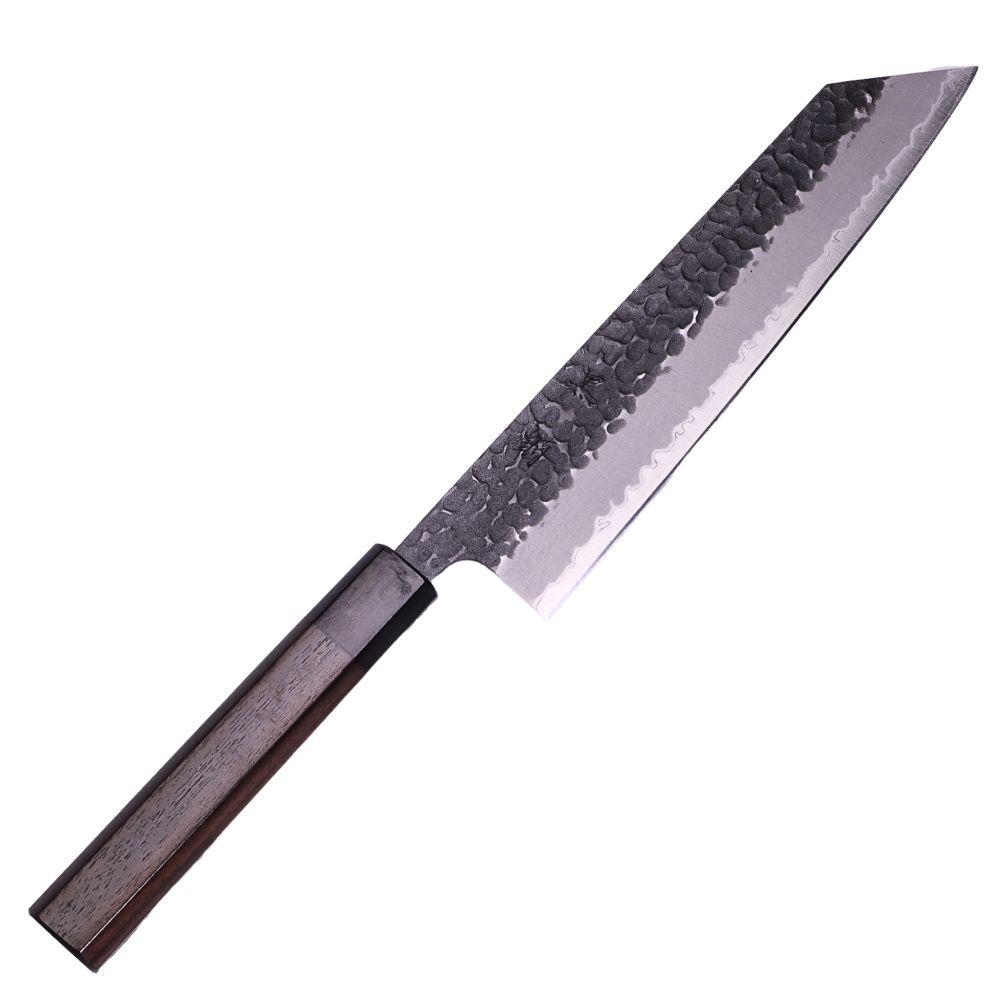
Ishizuchi Aogami Kiritsuke 210 mm
Specifications
| Total Length | 370 mm |
| Blade Length | 210 mm |
| Heel Height | 48 mm |
| Weight | 184 g |
| Blade Material | Aogami #2 (Blue Paper Steel No.2) – San Mai |
| Hardness | HRC 62–64 |
| Finish | Kurouchi |
| Handle | Japanese Octagonal Handle |
| Edging | Double Bevel (50/50) |
| Brand | Ishizuchi |
| Country of Origin | Japan |
Ishizuchi Aogami Kiritsuke 210 mm
The raw character of Tosa forging, with a tip made for precision
At first glance, what sets the Ishizuchi Aogami Kiritsuke 210 mm apart from a typical Gyuto is its clearly angled tip, often called a K-tip. But what makes this knife interesting isn't just its looks.
The K-tip makes the point slim and precise — ideal for scoring, trimming, cutting small pieces or slicing where you need fine control over where the tip goes. Meanwhile, most of the edge is fairly straight, so it suits push cuts well. This gives it a clearly different personality from a Gyuto.
Kiritsuke — but not quite a traditional Kiritsuke
The name Kiritsuke may bring to mind the traditional knife of professional Japanese kitchens, usually single-bevel and demanding real skill. But this Ishizuchi is double-bevel, 50/50, so it's better thought of as a modern Kiritsuke or K-tip Gyuto.
You get the look and benefits of the K-tip while still using it like an all-purpose chef's knife for meat, fish and vegetables — without learning to control a single-bevel knife. At 210 mm it's long enough to be your main knife on the board, but not so long that the K-tip becomes hard to control.
Aogami #2 — a steel that needs care, in return for what knife lovers seek
The cutting core is Aogami #2 (Blue Paper Steel No. 2) — a carbon steel, not stainless. It uses San Mai construction, with a hard steel core clad in softer metal on both sides, and a hardness of about HRC 62–64.
What you need to understand before buying: it can rust
Wash and dry it right after use, and don't leave it wet or with food on it for long. With use, the exposed steel may gradually develop a patina — completely normal for a carbon-steel knife.
In return you get a steel that takes a keen edge, holds it well and offers a sharpening feel that keeps many people devoted to carbon steel, even with so many easier-care stainless options around.
Kurouchi — marks deliberately left in place
The black finish on the upper blade is called Kurouchi — the scale left from forging and heat treatment, kept in part rather than polishing the whole blade bright.
Ishizuchi knives are made one by one by skilled craftsmen using Tosa methods. Tosa blacksmithing goes back more than 400 years and grew out of the need for tough tools in Kochi's forests. So the black marks aren't trying to make the knife look industrially perfect — they let you see its origins on the blade itself.
210 mm that still feels nimble
A 210 mm blade, yet only about 184 g, with a heel height of about 48 mm and an overall length of about 370 mm — a different feel from heavier Western full-tang knives. The Japanese octagonal handle keeps it light, so the focus is on the blade and edge control rather than handle weight.
So why not a Gyuto?
If you want a neutral knife that works with many techniques and has a more forgiving tip, a Gyuto may be the easier answer. But if you like a fairly straight edge, push cut often and want a tip that gets into detailed work precisely, a Kiritsuke has a personality a Gyuto can't match.
That is the charm of this Ishizuchi
It doesn't try to be the neatest-looking knife, or the easiest to care for, and it doesn't hide all the marks of its forging. What you get is:
- Aogami #2
- Kurouchi
- Tosa forging
- And a 210 mm Kiritsuke shape
If you just want a knife you can pick up without thinking, there are simpler options.
But for those who have started to fall for steel, forging and the personality of each knife,
the Ishizuchi Aogami Kiritsuke 210 mm has far more to discover than its sharpness.