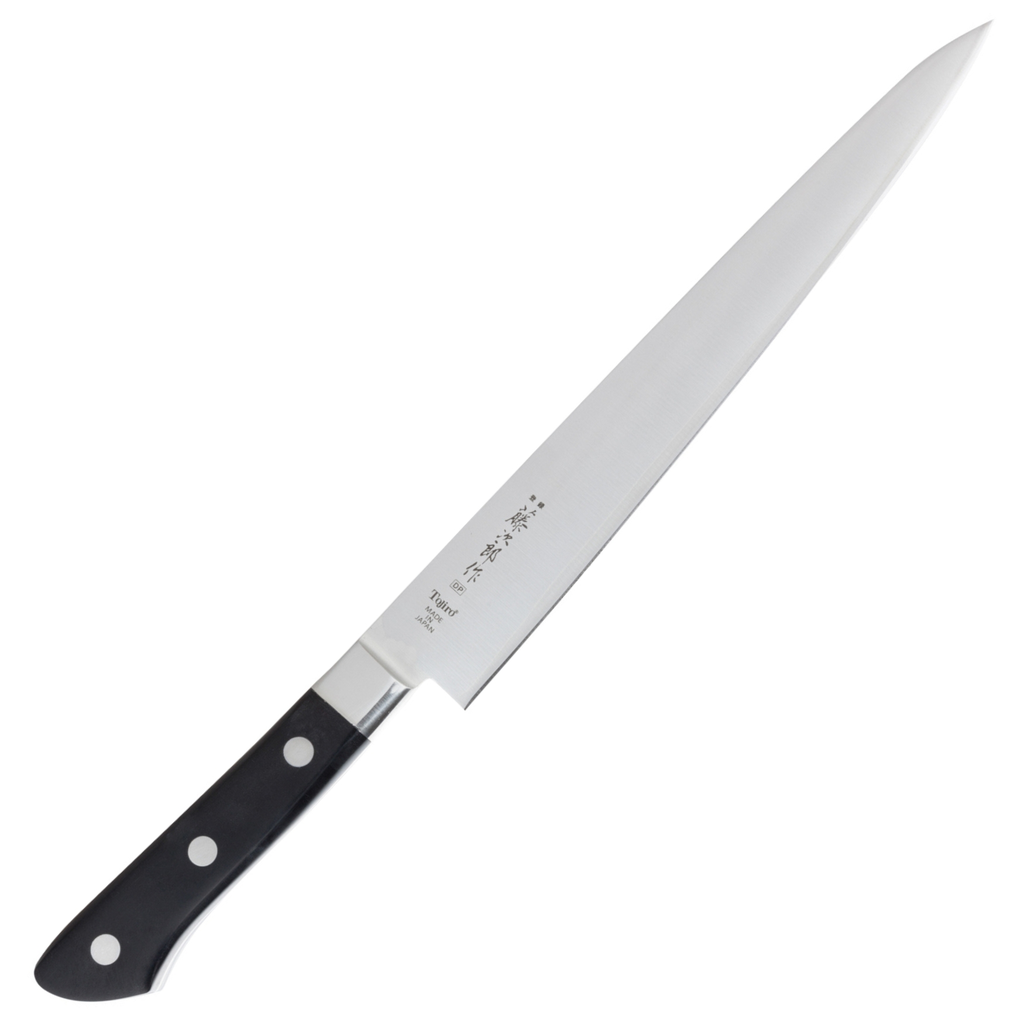
Tojiro DP Sujihiki 270 mm (F-806)
Specifications
| Overall Length | 395 mm |
| Blade Length | 270 mm |
| Weight | 220 g |
| Blade Material | VG10 + 13 Chrome Stainless Steel |
| Handle | Reinforced Laminated Material |
| Edge | Double-bevel edge |
| Brand | Tojiro |
| Country of Origin | Japan |
TOJIRO CLASSIC Sujihiki 270 mm — F-806
When 240 mm still isn't long enough for the stroke you want
The logic of a Sujihiki is very simple:
the more you can finish a cut in one long, continuous stroke, the smoother and cleaner the cut surface.
So the 270 mm TOJIRO CLASSIC F-806 isn't simply an F-805 that is 30 mm longer.
The extra length is there to add slicing distance.
When working with roast beef, large cuts of meat, ham or fish, you can start the stroke from the heel and still have enough edge left to travel further through the ingredient —
instead of stopping short and having to pull the knife back to start again.
Length that protects the cut surface
When slicing meat, what we don't want is to "saw".
The more the knife moves back and forth, the more chance there is of marking the surface of the meat.
The F-806's 270 mm blade lets you use long draw cuts.
Place the edge — draw through — and let the cut finish.
With small pieces of meat, this advantage may not be obvious.
But as the ingredients get bigger, you immediately see the benefit of a Sujihiki's blade length.
Long, but not big
The F-806 has a blade of about 270 mm, but the Sujihiki profile is much narrower than a Gyuto — because you don't need more blade area like when cutting vegetables on a board, but a long edge with only as much blade as necessary.
A Sujihiki's job is to draw through the ingredient, using the sharpness of the edge to separate it as cleanly as possible — unlike a Gyuto, which combines cutting force with sharpness.
The TOJIRO F-806 has an overall length of 395 mm and weighs about 240 g, even with a blade as long as 270 mm.
So which should you choose, F-805 or F-806?
Both knives work the same way.
The difference is the scale of the work.
- F-805 — 240 mm: for those who want a Sujihiki that is still agile, takes up little space, and mainly handles standard-size meat or fish.
- F-806 — 270 mm: for when the work gets bigger, you need a longer draw cut, or you regularly portion and slice continuously.
So 270 mm isn't "better" than 240 mm.
It simply gives more room for the cutting stroke.
And if your work can make use of that room, a difference of just 30 mm means a great deal.
Works for fish, but it isn't a Yanagiba
A Sujihiki can stand in for a sashimi knife in some ways, because its long, narrow blade is well suited to slicing fish.
But the F-806 is double bevel, so it has a different character from the traditional single-bevel Japanese Yanagiba.
The advantage is that the F-806 is more approachable, works for both left- and right-handed users, and isn't limited to sashimi.
Today it might be slicing fish,
tomorrow roast beef,
then back to portioning meat for service.
This is the flexibility of a Western-Japanese Sujihiki.
If you already have an F-805, the F-806 still works the same way.
It is still a Sujihiki.
Still made to slice.
For those who work with large cuts of meat, fish, or use a Sujihiki as part of their daily work, those 30 mm could mean the change from
"two strokes"
to
"one is enough".
And that is the reason for
TOJIRO CLASSIC F-806