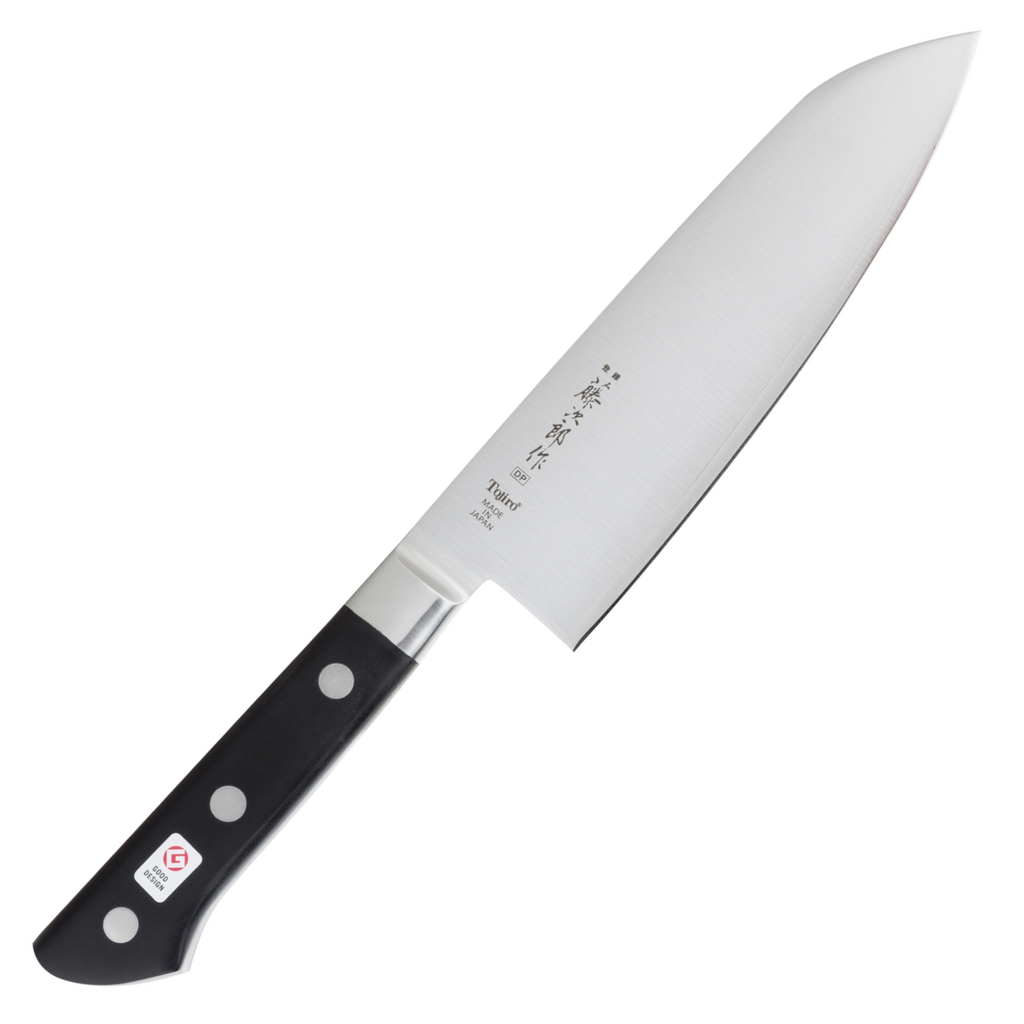
Tojiro DP Santoku 170 mm (F-503)
Specifications
| Overall Length | 295 mm |
| Blade Length | 170 mm |
| Weight | 180 g |
| Blade Material | Cobalt Alloy Steel (VG10) + 13 Chrome Stainless Steel |
| Handle | Reinforced Laminated Material |
| Edge | Double-bevel edge |
| Brand | Tojiro |
| Country of Origin | Japan |
TOJIRO CLASSIC Santoku 170 mm — F-503
A knife born when the Japanese kitchen changed
Before the Santoku, Japanese kitchens already had the Nakiri for vegetables. Then in the Meiji era, as Western culture and meat-eating spread into Japan, Western-style knives such as the Gyuto began to play a role.
But in the Showa era, Japanese lifestyles changed:
- Kitchens became smaller
- A single meal included vegetables, meat and fish
- And people didn't want to change knives every time they changed ingredients
So a simple idea arose: what if you combined the strengths of the Nakiri and the Gyuto in one knife? That is where the Santoku came from.
“Three virtues” in a single knife
The word Santoku (三徳) roughly means “three virtues” or “three abilities” — referring to use with meat — fish — vegetables.
The blade keeps the width and fairly straight edge of a vegetable knife, but adds a tip that handles meat, fish and detail work better than a Nakiri. It isn't as specialized as a Nakiri, nor as long or pointed as a Gyuto.
But that is exactly what made the Santoku the everyday knife of so many Japanese homes — it gives up some specialist strength in exchange for doing many jobs with just one knife
F-503 — 170 mm, chosen for good reason
The TOJIRO CLASSIC F-503 has a 170 mm blade, an overall length of about 295 mm and weighs about 190 g. It is clearly shorter than the popular 210–240 mm Gyuto, yet has enough blade for most everyday prep. On a modest cutting board, it feels nimble.
- Easy for cutting vegetables
- Handles meat
- Works for prepping filleted fish
- And the tip handles detail work better than a Nakiri
That's why the F-503 doesn't stand out for being the best at any single job — it stands out because it almost never forces you to switch knives.
If you already have a Gyuto, do you still need a Santoku?
Not necessarily — the Gyuto is also an all-purpose knife for meat, fish and vegetables. The difference is how it feels to use.
If you like a long blade with a pointed tip and slice a lot, a Gyuto usually gives more working room. But if you prefer a shorter, wider knife that's easy to control, with most of your work happening right in front of you on the board, the Santoku makes sense.
So the Santoku shouldn't be seen as a short version of the Gyuto — it comes from a different way of thinking from the start.
A design that has been with TOJIRO for over four decades
The name DP TOJIRO 8000 F-503 Santoku appears in the Good Design records as early as 1981, together with the F-502 Nakiri, and TOJIRO's current F-503 product page also mentions the Good Design and Long-Life Design Award in 1996.
So looking at the F-503 today, you aren't looking at a shape invented to follow the overseas trend for Japanese knives, but a form TOJIRO has made and refined for decades.
This is the charm of the F-503
The F-502 tells us that if most of your work is vegetables, use a knife born for vegetables. But the F-503 comes from a different question: what if you don't know what the next ingredient will be?
It might be an onion, then meat, then fish, and then back to slicing spring onions.
If you want to pick up just one knife and keep going through all of it — that is why the Santoku was born
And it is still the reason for the TOJIRO CLASSIC F-503 today.