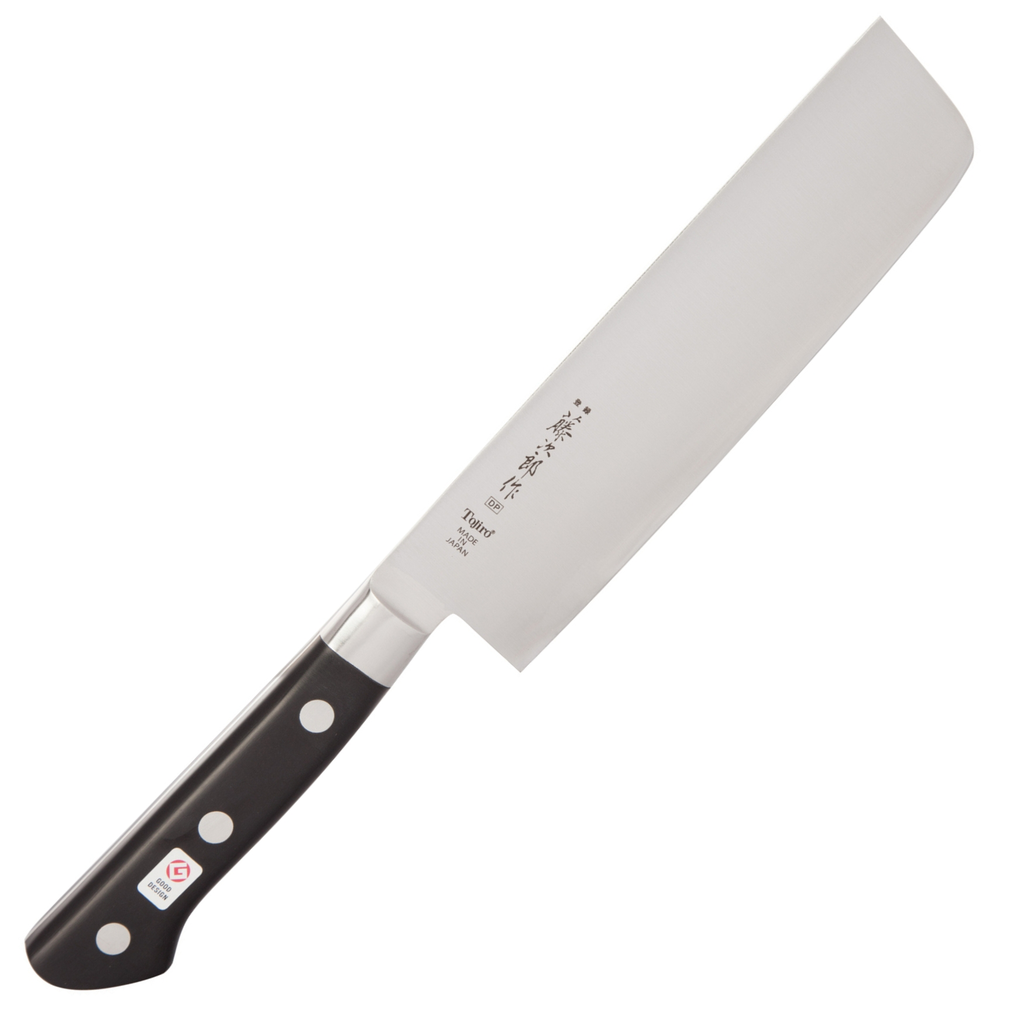
Tojiro DP Nakiri 165 mm (F-502)
Specifications
| Overall Length | 295 mm |
| Blade Length | 165 mm |
| Weight | 180 g |
| Blade Material | Cobalt Alloy Steel (VG10) + 13 Chrome Stainless Steel |
| Handle | Reinforced Laminated Material |
| Edge | Double-bevel edge |
| Brand | Tojiro |
| Country of Origin | Japan |
TOJIRO CLASSIC Nakiri 165 mm — F-502
Before the Santoku, Japanese kitchens already had the Nakiri
Today, when people think of an everyday Japanese kitchen knife, many picture a Santoku or a Gyuto.
But the Nakiri is actually a much older shape.
The vegetable-knife shape of the Nakiri developed in Japan as early as the Edo period — before the Western-style Gyuto arrived with the meat-eating culture of the Meiji era, and before the Santoku was born later on.
Its origin is very simple.
Japanese cooking uses a lot of vegetables, so a knife made specifically for cutting vegetables came into being.
A shape born from function
The Nakiri has a wide blade, a squared-off tip and a fairly straight edge. It doesn't need a pointed tip like a Gyuto, because the main work happens right in front of you on the cutting board.
As the blade comes down, the edge meets the board along almost its entire length — ideal for slicing spring onions, onions, cabbage, cucumber, carrots, mushrooms and all kinds of leafy greens.
The wide blade has another benefit: once you finish cutting, you can use the side of the blade to gather the ingredients and move them straight into a bowl.
Cut — gather — move — and back to cutting.
So the Nakiri's shape didn't come from looks, but from the way work is done on the cutting board.
F-502 — the Nakiri, TOJIRO CLASSIC style
The F-502 has a 165 mm blade, a compact size well suited to the Nakiri's job, with an overall length of about 295 mm and a weight of about 200 g.
It is double bevel, so it works for both left- and right-handed users — unlike the traditional Japanese Usuba, which is usually single bevel and takes more skill to use.
That makes the F-502 an easy-to-use Japanese vegetable knife.
- You don't need to be a Japanese chef
- You don't need any special technique
Just put vegetables on the board, and you'll immediately understand why the blade was made in this shape.
And it isn't a cleaver
Its rectangular shape and wide blade may make it look like a chopping knife, but the Nakiri is not a knife for chopping bones. The F-502's edge is made for cutting food, not for taking the impact of hard bones.
So what makes it special isn't weight or power,
but working with vegetables in a direct, agile way.
An old shape, but not outdated
What's interesting about the F-502 is that this model number has a long design history. The DP TOJIRO 8000 F-502 received the Good Design Award back in 1981, and today's F-502 continues that line within the TOJIRO CLASSIC family.
Decades have passed, and its basic shape hardly needs any new explanation:
- A wide blade
- A fairly straight edge
- A 165 mm size
- And a clear purpose
Put vegetables on the board, and cut them well.
In an age when we often look for one knife that can do everything, the F-502 reminds us of another view:
Sometimes a good knife
doesn't need to do everything.
It just needs to do what it was made to do —
really well.